
One concrete problem
Start with a service or process that has demand, accountable owners and an observable baseline.
PRACTICAL GUIDE · COSTA RICA · 2026
A path for turning a public need into a useful, measurable and governed service—without handing institutional decisions to a black box.
SIX CONDITIONS FOR SUCCESS
Start with a service or process that has demand, accountable owners and an observable baseline.
Define what information the AI may consult, which source remains authoritative and how it is updated.
Keep legal, financial, technical and discretionary decisions with accountable officials.
Connect existing systems through bounded permissions, clear contracts and traceability.
Test responses, actions and failures before expanding scope; when uncertain, abstain or escalate.
Compare time, resolution, quality, adoption and exceptions against an agreed baseline.
01
In local government, a useful implementation connects service, knowledge, data, tools and accountable owners. A conversational channel may be visible, but value appears when the institution can resolve, verify, escalate and preserve evidence.
The right question is not “which model should we buy?” but “which public service do we want to improve, with what evidence and under whose authority?”
02
Prioritize a case with real demand, accessible information and an accountable owner. Not every process needs AI, and not every automation needs a generative model.
High volumes of repeated questions, multiple formats and a need for continuous service.
WATCH FORDo not turn general guidance into an official ruling or decision.Applications, requirements, corrections, documents, inspections and owners are fragmented.
WATCH FORAI may prepare and verify; the competent authority decides and signs.Regulations, resolutions, manuals and questions whose answers change over time.
WATCH FOREvery answer should preserve its source, validity period and a correction path.Manual classification, extraction, review and transfer of information between systems.
WATCH FOROCR or extraction is not truth: sensitive fields require validation.Assignment, geographic evidence, checklists and continuity with the case file.
WATCH FORMap context does not replace a verified inspection when one is required.Queues, deadlines, exceptions and workloads that need follow-up.
WATCH FORA prediction must not hide its formula, data or uncertainty.03
If several answers are “no,” the first deliverable should be diagnosis and design—not a production integration.
04
Layers may vary, but boundaries should remain clear: conversing, consulting, executing, recording and deciding are different responsibilities.
Conceptual architecture. The Municipal Agentic Assistance System and the TITAN Ecosystem are complementary, distinct layers. Each institution defines which ones it uses and which integrations it authorizes.
Each integration accesses only the operations and data it needs.
If evidence is insufficient or a source fails, the system abstains or escalates.
The municipality retains authority over its data, rules and decisions.
05
Do not evaluate a demonstration alone. Ask for evidence about the complete system and what happens after launch.
06
The schedule is indicative. Data, procurement, integrations and authorizations may extend it. The goal is to advance based on evidence—not deadline pressure.
Reference weeks 1–2
Reference weeks 3–5
Reference weeks 6–8
Reference weeks 9–12
07
A metric should include unit, formula, period, source, exclusions and cutoff date. “Messages processed” alone does not mean better public service.
First response time · resolution · abandonment · channel availability
Grounded answers · correct abstentions · errors · corrections
Cases processed · manual work avoided · queues · exceptions · rework
Residents served · active staff · recurrence · satisfaction
Auditable actions · incidents · escalation · correction time
08
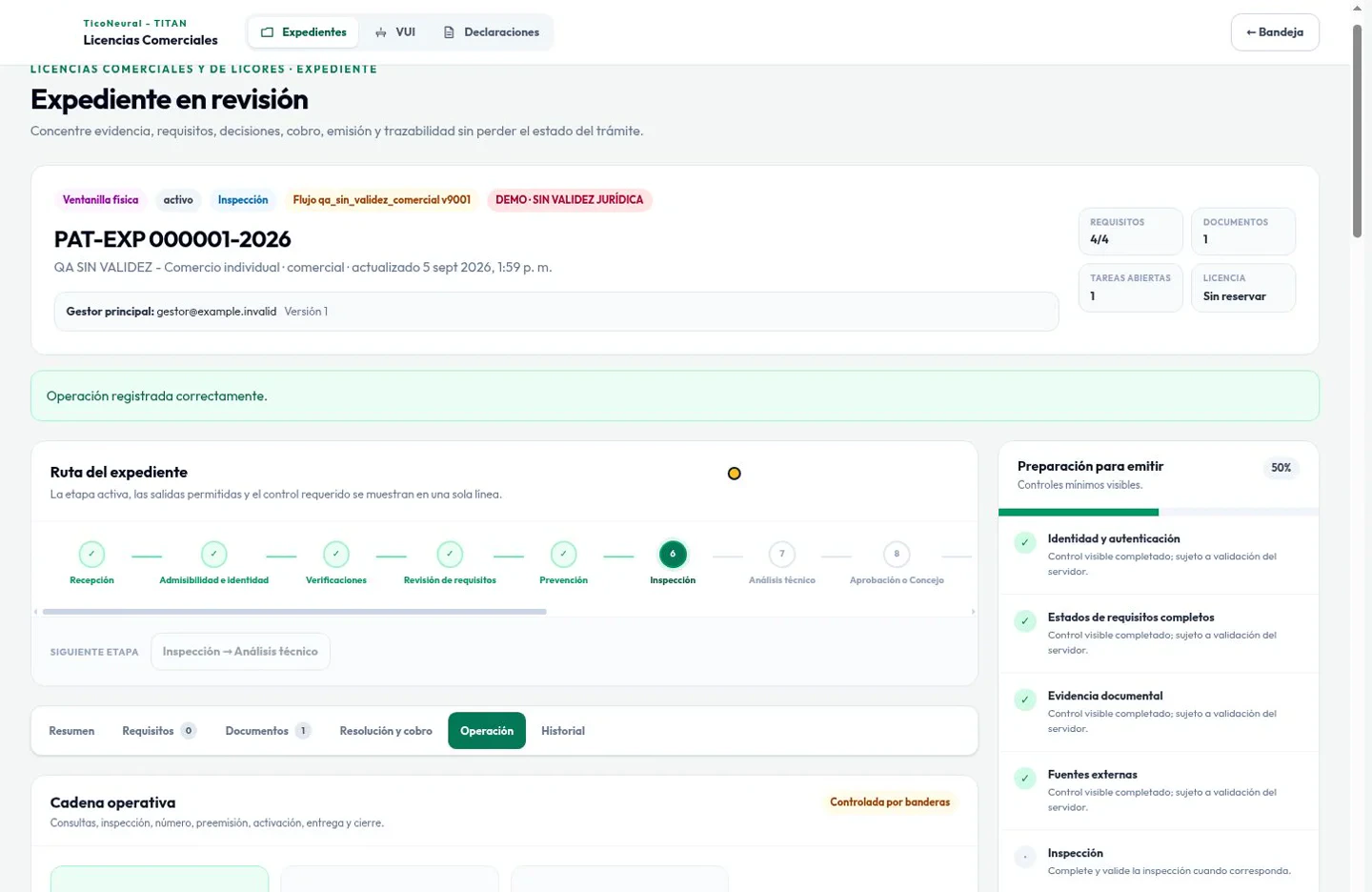
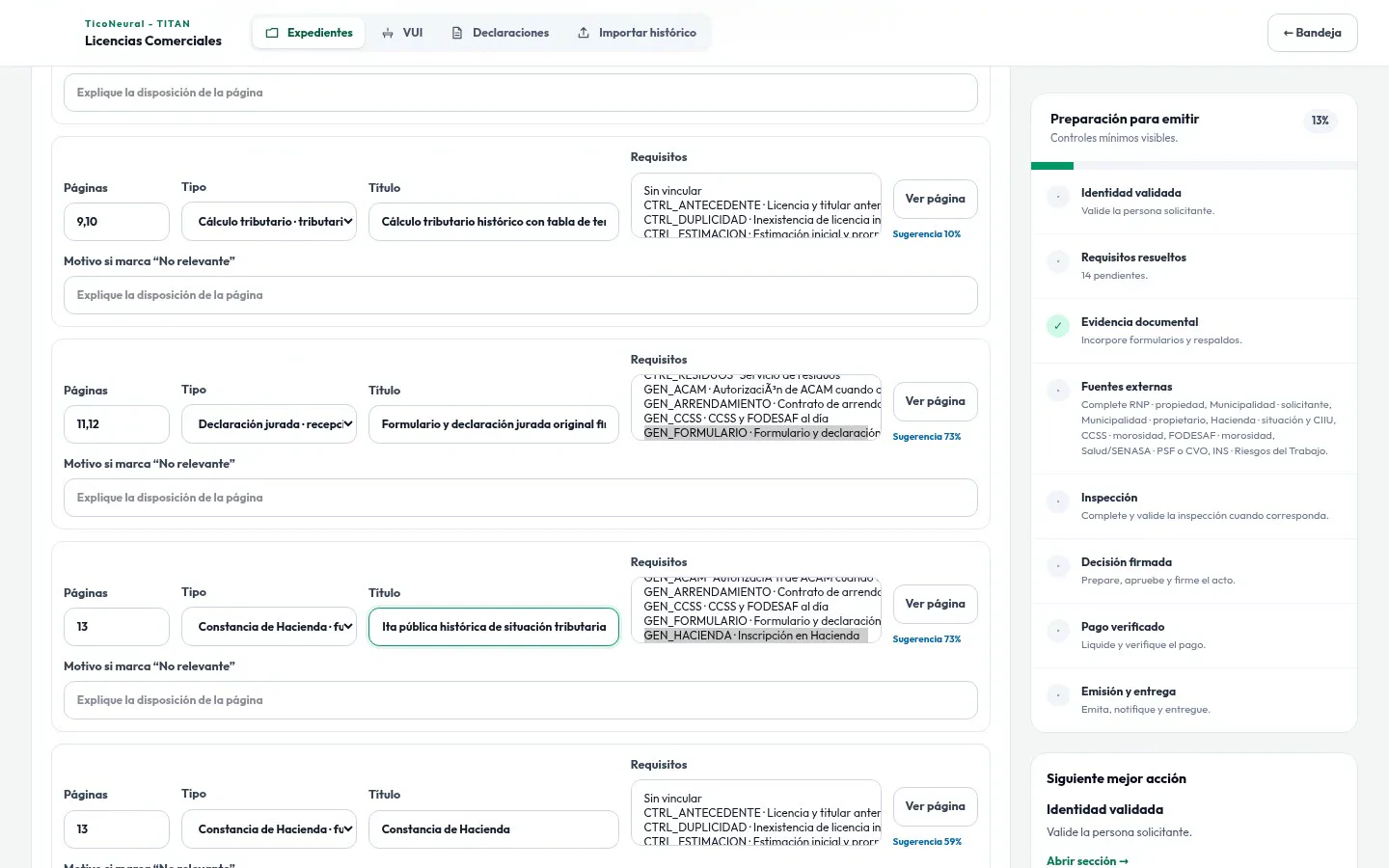
The Municipality of Puriscal’s official land-use page embeds the TITAN municipal form and publicly links to the product page. This demonstrates the presence of the entry point in an institutional operation; it is not, by itself, an independent impact measurement.
PRIMARY SOURCE
09
Not necessarily. Conversation can be a useful interface, but the project should begin with an operational problem, its sources, owners and boundaries. In some cases the best first step is internal knowledge, documents, inspections or a digital case file.
It may guide, prepare, verify and execute authorized tasks. Legal, financial, technical and discretionary decisions should remain with the competent authority and be documented.
No. An implementation can work around existing software through APIs, databases, files, events or authorized adapters. When a legacy system must be modernized, the migration requires its own controls.
Bound sources and tools, test retrieval, require references where appropriate, and define abstention and escalation rules. No design eliminates every error; continuous measurement and correction are therefore required.
It depends on the process, data, integrations, authorizations and procurement. This guide presents a twelve-week reference path for a bounded capability, not a universal delivery promise.
Purpose, scope, sources, roles, data processing, ownership and portability, service levels, security, testing, metrics, change management, incidents and exit. Legal wording must be validated for each institution.
10
This guide combines the author’s technical experience with public frameworks and sources. References are provided for verification and further reading; inclusion does not imply endorsement of TicoNeural by those organizations.
NEXT STEP
TicoNeural can help map the process, identify sources and risks, and define a measurable first scope before committing to a larger implementation.